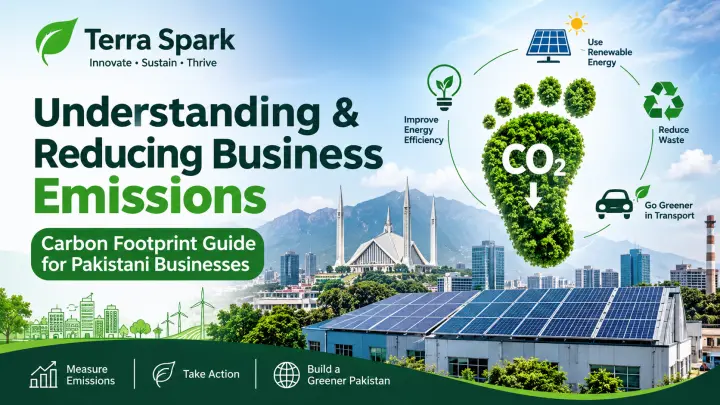
Terra Spark’s Carbon Footprint Guide for Pakistani Businesses
A business’s carbon footprint is the greenhouse-gas emissions associated with its activities. These emissions can come from electricity, fuel, company vehicles, purchased materials, deliveries, waste and other parts of the value chain. Measuring them helps a business understand where its biggest environmental impacts come from and where practical improvements may be possible.
This guide from Terra Spark explains how businesses in Pakistan can begin measuring, understanding and reducing their carbon footprint. It provides a practical starting point for organizations looking to improve energy efficiency, strengthen sustainability practices and make more informed environmental decisions.
What Is a Business Carbon Footprint?
A carbon footprint is the total greenhouse-gas emissions linked to an activity, organization, product or service. It is commonly expressed as carbon dioxide equivalent (CO₂e), which provides a standard way of representing different greenhouse gases in a single measurement.
For a business, its carbon footprint may include emissions from its own operations as well as emissions associated with the goods and services it purchases, sells, transports or uses.
Why Should Pakistani Businesses Measure Their Carbon Footprint?
Measuring emissions gives businesses a clearer understanding of how they use energy, fuel and other resources. It can help management identify opportunities to improve operational efficiency, track environmental performance and respond to sustainability-related requests from customers, investors or business partners.
For Pakistani businesses, measuring emissions can also help identify opportunities related to electricity consumption, generator fuel use, transportation, manufacturing processes and resource management.
- Identify high electricity and fuel consumption.
- Find opportunities to improve energy efficiency.
- Develop measurable environmental goals.
- Improve sustainability reporting and business transparency.
- Understand environmental impacts across supply chains.
- Support informed operational and investment decisions.
- Prepare for sustainability-related expectations from international customers and partners.
Understanding Scope 1, Scope 2 and Scope 3 Emissions
Greenhouse-gas emissions are commonly categorized into three scopes to help businesses understand where their emissions originate.
Scope 1 · Direct Emissions
Emissions from sources owned or controlled by the business.
- Generators and fuel combustion
- Company-owned vehicles
- Boilers and industrial processes
- Refrigerant leakage, where applicable
Scope 2 · Purchased Energy
Emissions associated with purchased energy used by the business.
- Purchased electricity
- Heating or cooling
- Lighting and machinery
- Offices and production facilities
Scope 3 · Value Chain
Other indirect emissions connected to the business value chain.
- Purchased goods and materials
- Third-party transport
- Employee commuting and travel
- Waste and product lifecycle
For businesses in Pakistan, diesel generators used during electricity interruptions can be an important source of Scope 1 emissions, while purchased electricity may contribute to Scope 2. Scope 3 can include supplier materials, delivery services, business travel and waste.
Businesses may not have complete data for every category initially. They can begin with the most relevant sources, document information gaps and improve their estimates over time.
How to Measure a Business Carbon Footprint
A basic greenhouse-gas emissions calculation combines activity data with an appropriate emissions factor. Activity data measures what a business does or consumes, while an emissions factor estimates the greenhouse-gas emissions associated with that activity.
Electricity consumption may be measured in kilowatt-hours (kWh), while fuel consumption may be recorded in litres.
Step 1 · Define Your Business Boundary
Determine which locations, operations, activities and reporting periods are included. For example, a company may measure emissions from its head office, manufacturing facility, warehouse and company vehicles over one financial year.
Step 2 · Identify Emission Sources
List activities that may generate emissions, including electricity, generator fuel, company vehicles, heating and cooling equipment, purchased materials, transportation, business travel and waste disposal.
Step 3 · Collect Activity Data
Gather electricity bills and meter readings, fuel records, vehicle mileage, purchasing invoices, waste records, transportation and travel information. Accurate records improve the reliability of estimates.
Step 4 · Select Appropriate Emissions Factors
Use reliable factors that match the activity, geographical location, reporting period, units and methodology. Electricity factors should reflect the relevant electricity system and reporting period where suitable data is available.
Step 5 · Calculate Your Emissions
Multiply the activity data by the relevant emissions factor.
Example: If a business records 1,000 kWh of electricity consumption, multiply that consumption by the applicable electricity emissions factor to estimate emissions. If the factor is expressed in kg CO₂e per kWh, the result will be in kg CO₂e.
This is an illustrative example only. Select the actual factor from an appropriate source for the location and reporting period.
Step 6 · Record Assumptions and Review Results
Keep activity data, factors, units, methods and assumptions together. Check missing records, incorrect units, duplicates, inconsistent periods, unusual consumption changes and data gaps.
Step 7 · Repeat and Improve
Repeat measurement regularly using consistent boundaries and methods where possible. For formal reporting, follow a recognized greenhouse-gas accounting standard and seek qualified sustainability advice where needed.
Common Sources of Emissions in Pakistani Businesses
1. Electricity Consumption
Lighting, air conditioning, machinery, computers, refrigeration and production equipment use electricity. Review bills and meter readings to identify consumption patterns and potential efficiency improvements.
2. Generator and Fuel Consumption
Diesel and petrol generators, boilers and other fuel-powered equipment can contribute to direct emissions. Track fuel consumption, operating hours and maintenance records.
3. Transportation and Logistics
Company vehicles, staff commuting, delivery services, freight and business travel may contribute to emissions, particularly for businesses with fleets or distribution networks.
4. Purchased Goods and Materials
Steel, cement, plastics, packaging, paper and other purchased materials may have emissions associated with their production. Review purchasing patterns and look for opportunities to reduce material use.
5. Waste Generation
Waste disposal and treatment may contribute to greenhouse-gas emissions. Record waste quantities and types, then explore reduction, reuse and recycling options.
6. Business Travel
Flights, road travel and other business journeys can contribute to a company’s footprint. Track travel frequency, distances and modes to identify opportunities to reduce unnecessary trips.
Practical Ways to Reduce Your Carbon Footprint
Improve Energy Efficiency
- Replace inefficient lighting with LED lighting.
- Improve air-conditioning efficiency.
- Maintain machinery and electrical equipment.
- Reduce unnecessary electricity consumption.
- Improve building insulation where practical.
- Monitor electricity use regularly.
Energy-efficiency improvements can also help businesses manage operating costs.
Manage Generator and Fuel Use
Monitor generator operating hours and fuel consumption. Maintain equipment according to manufacturer recommendations and investigate unusual fuel consumption. Where practical, evaluate alternative energy and backup-power strategies.
Review Transportation and Deliveries
- Plan delivery routes and reduce unnecessary trips.
- Maintain vehicles properly.
- Improve load planning.
- Encourage efficient commuting options where practical.
- Ask transport providers about environmental performance.
Reduce Material Use and Waste
- Reduce excessive packaging.
- Reuse suitable materials.
- Improve inventory management.
- Separate recyclable waste.
- Reduce avoidable production waste.
- Track waste quantities over time.
Work With Suppliers
Ask key suppliers for environmental information, review packaging practices and explore more efficient transportation or purchasing arrangements. Focus initially on suppliers and materials that represent a significant portion of your purchasing.
Explore Renewable Energy
Where technically and financially feasible, assess renewable energy options such as solar power. Evaluate energy requirements, installation costs, operational needs and applicable accounting or reporting rules.
Set Clear, Measurable Targets
Define what will change, the period covered and how progress will be measured. For example, a business might aim to reduce electricity consumption per unit of production over a defined period.
How to Track Carbon-Footprint Progress
A consistent record helps businesses understand whether environmental initiatives are making a difference.
| Metric | What to Track |
|---|---|
| Electricity | Monthly kWh consumption |
| Generator fuel | Litres of diesel or other fuel |
| Vehicles | Fuel use and kilometres travelled |
| Waste | Quantity and type of waste generated |
| Purchasing | Relevant materials and supplier information |
| Emissions | Estimated kg or tonnes CO₂e |
| Targets | Baseline, target and progress |
Compare similar reporting periods and operational boundaries. Comparing the same facilities across two years may be more meaningful than comparing different sites or operating conditions. Document any change in calculation method or boundary.
Common Carbon-Footprint Measurement Mistakes to Avoid
- Leaving out important sources: Use a source checklist before collecting data.
- Mixing units or periods: Keep activity records consistent.
- Using unsuitable emissions factors: Match factors to activity, location, units and reporting period.
- Double counting: Document categories and avoid counting the same activity more than once.
- Making unsupported claims: Claims such as “carbon neutral” or “zero emissions” need evidence and defined boundaries.
- Treating estimates as verified: Clearly state methods, assumptions and limitations.
Frequently Asked Questions
What is a business carbon footprint?
It is the greenhouse-gas emissions associated with an organization's activities, including energy, fuel, transport, materials, waste and other operations, commonly expressed as CO₂e.
How can a small business in Pakistan measure its carbon footprint?
Start with electricity bills, fuel records, vehicle information and available purchasing or waste data. Identify sources, select suitable emissions factors and estimate emissions for a defined period.
What are Scope 1, Scope 2 and Scope 3 emissions?
Scope 1 covers direct emissions from owned or controlled sources. Scope 2 covers emissions associated with purchased energy. Scope 3 includes other indirect value-chain emissions, such as purchased goods, transport, travel and waste.
Do all businesses have the same carbon footprint?
No. A factory, office, retailer, logistics company and service provider have different emissions sources depending on their energy use, activities, transport, materials and supply chains.
Does measuring emissions automatically reduce them?
No. Measurement helps identify emissions and improvement opportunities. Actual reductions require action, implementation and monitoring.
Should a business include Scope 3 emissions?
Where relevant, Scope 3 can provide a fuller view of value-chain impacts. Businesses can begin with significant categories and improve data gradually.
Can businesses use estimated emissions for environmental claims?
Claims should be specific, transparent and supported by evidence. Explain what was measured, the period covered and limitations. Seek expert review for formal or high-impact claims.
How often should a business measure its carbon footprint?
Many organizations report annually while tracking activity data monthly or quarterly. Frequency depends on size, reporting requirements and objectives.
Start With What You Can Measure
A credible carbon-footprint process begins with clear boundaries, reliable records and transparent assumptions.
Pakistani businesses can start with their main electricity and fuel sources, identify opportunities to improve efficiency, establish a baseline and gradually develop a more complete emissions inventory.
Measuring emissions is not simply a reporting exercise. It can help businesses understand resource consumption, identify operational improvements and make more informed decisions about environmental performance.
Terra Spark supports businesses in exploring practical sustainability solutions, environmental awareness and strategies for a more resource-efficient future.
References and Further Reading
- Greenhouse Gas Protocol – Corporate Accounting and Reporting Standard
- IPCC – Climate Change Assessment Reports and Greenhouse-Gas Guidance
- Relevant national environmental and energy publications in Pakistan
This guide is intended for general educational purposes and does not replace formal greenhouse-gas accounting, regulatory advice or third-party verification.