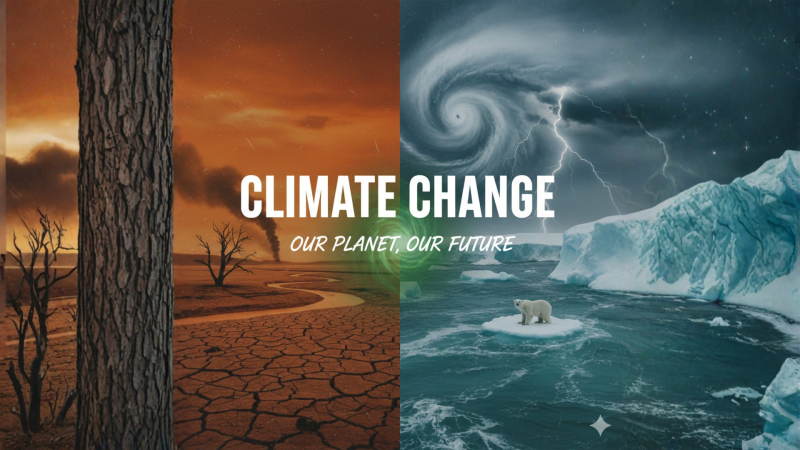
The Rising Crisis We Can No Longer Ignore
Pakistan is one of the most climate-vulnerable countries in the world. Consistently ranked in the top 10 of the Global Climate Risk Index for more than two decades, we are paying for carbon emissions we barely contributed to. Less than 1 percent of global greenhouse gases come from Pakistan, yet we are facing some of the worst impacts on the planet.
Proof of Destruction: 2022 Floods and Beyond
The super floods of 2022 were a brutal wake-up call. One-third of the country went underwater. More than 33 million people were affected, 1,700 lost their lives, and economic losses crossed $30 billion. Whole villages were washed away in Sindh and Balochistan. Infrastructure built over decades was destroyed in days.
And 2022 was not an exception, it was a preview.
2024 – Sindh and Punjab experienced record-breaking heatwaves, where the temperatures surged above 52°C.
The glaciers are melting at an alarming rate in Gilgit-Baltistan; millions are now under threat of Glacial Lake Outburst Floods.
Various monsoon patterns are consistently causing acute floods in tandem with long droughts within the same year.
The Human Cost
Agriculture, which employs 42% of our workforce and contributes 19% to GDP, is under severe threat. Erratic rains, heat stress, and water scarcity are reducing yields of wheat, rice, and cotton.
Water insecurity: Our lifeline, the Indus River system, is threatened by reduced glacier flow and upstream dams. Pakistan will become a water-scarce country by 2025.
Displacement: Millions have already become climate migrants inside the country, especially from Thar, Balochistan, and coastal Sindh where sea-level rise and cyclones are eating away land.
Why Is Pakistan So Vulnerable?
- Geography: We sit at the crossroads of melting Himalayas, the Arabian Sea, and the Thar Desert.
- Poverty: Lack of resources to create resilient infrastructure or early warning systems.
- Population pressure: over 240 million people dependent on climate-sensitive livelihoods.
What Are We Doing About It?
The good news is that awareness is growing.
- More than a billion trees were planted in Pakistan under the Ten Billion Tree Tsunami Programme.
- The National Climate Change Policy of 2021 and the updated Nationally Determined Contributions target a share of renewable energy at 60% by 2030.
- Projects like the Recharge Pakistan initiative and Living Indus Initiative are trying to restore ecosystems.
- Young activists, students, and local NGOs are raising their voices louder than ever.
But let’s be honest, the pace is too slow, and international climate finance-the promised $100 billion a year to developing nations-is still a trickle. Pakistan needs billions, not millions, to adapt and build resilience.
What Can You Do Right Now?
- Reduce your carbon footprint— switch to energy-efficient appliances, use public transport, reduce food waste.
- Support local organisations working on climate adaptation, such as WWF-Pakistan, LEAD Pakistan, and HANDS.
- RAISE YOUR VOICE: Tag policymakers, share facts, and demand climate justice.
- Vote for leaders who take the climate emergency seriously. This is not a crisis that has been created by Pakistan, yet we are suffering the worst consequences. The time for denial is over. The time for urgent, collective action is now. If we don’t act today, tomorrow our children will inherit a country where summers are unbearable, winters are unpredictable, and large parts of Sindh and Balochistan are either underwater or turned into desert.