A morning that began with smoke
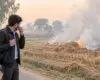
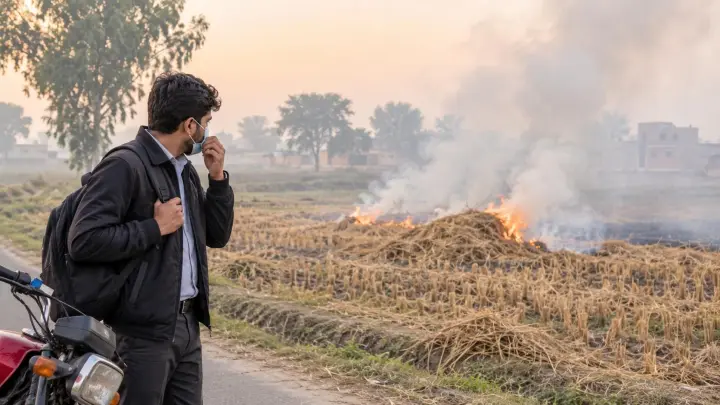
It was a cool November morning in Punjab. Ali, a young office worker, left home earlier than usual. He had an important meeting and hoped to reach the city before traffic became heavy. As his motorcycle moved along the road, the familiar winter haze slowly turned into something thicker. His eyes began to water. His throat felt dry, and he could barely see the fields beyond the roadside trees.
A few minutes later, Ali noticed flames in a harvested field. A farmer was burning the dry remains of a previous crop. Smoke was spreading across the road and blending with the haze already hanging over the area. Ali slowed down, covered his mouth and wondered why the remains of a harvest were being set on fire.
At the office, he mentioned what he had seen to a colleague whose family owned a small farm. The colleague explained that after harvesting, farmers often have only a short time to prepare their fields for the next crop. Collecting and transporting leftover stalks can require labour, machinery and money. When affordable alternatives are not available at the right time, burning may seem like the quickest option.
Ali realised that the smoke was not simply a problem of careless behaviour. It was also connected to a practical challenge: what should farmers do with large amounts of crop residue when the next planting season is approaching?
This story is illustrative, but the issue is real. The Punjab Agriculture Department identifies crop-residue burning as a contributor to smog and describes alternatives such as super seeders, rice-straw shredders and other residue-management practices. FAO has also worked with Punjab institutions to study the relationship between crop-residue burning and smog in the rice-wheat belt. In March 2025, the World Bank also approved a US$300 million loan for the Punjab Clean Air Programme, which supports the province’s smog-mitigation plan across sectors that include agriculture.
The problem does not end when the smoke disappears
Crop residues include rice straw, wheat straw, cotton stalks, maize cobs, sugarcane trash and orchard prunings. These materials are produced in large quantities during harvesting seasons. If they are burned in the open, smoke and particulate pollution can affect nearby communities. Burning can also damage soil organic matter and remove nutrients from the field.
But simply removing every leftover plant material is not always the answer. Crop residues can protect the soil, contribute organic matter and support nutrient cycling. Some residues may already be used as animal feed, bedding or other local products. The best approach depends on the crop, soil, moisture, location, available machinery and farmers’ needs.
The real challenge is to manage each type of residue wisely instead of treating all of it as useless waste.
A different question: what if agricultural waste became a resource?
A few days later, Ali visited his colleague’s family farm. This time, instead of seeing a field on fire, he saw crop residues being collected and sorted. His colleague explained that agricultural waste could follow several different pathways. Some material could be returned to the soil. Some could be composted. Suitable biomass could be used for controlled energy production or converted into biochar.
That was Ali’s first introduction to the idea of a circular bioeconomy: a system in which biological resources are used carefully, waste is reduced, and materials are recovered and reused wherever practical. Rather than following a one-way pattern of growing, using and throwing away, a circular system tries to keep useful resources in circulation.
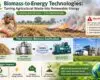
Figure 1. A simplified circular pathway: agricultural residues are collected, processed into useful products, and nutrients or byproducts are returned to productive use.
Turning one problem into several practical solutions
1. Return suitable residues to the soil
Not every residue needs to leave the farm. Shredding, mulching, minimum tillage and in-situ incorporation can help manage crop remains while returning organic material to the soil. Machinery such as super seeders can help farmers sow the next crop without first burning the stubble. The Punjab Agriculture Department’s smog strategy includes support for super seeders and rice-straw shredders as alternatives to open burning.
2. Convert organic material into compost
Where the material is suitable, crop residues can be mixed with other organic inputs and processed into compost. Proper composting turns biodegradable material into a soil amendment that can support soil structure and nutrient recycling. It requires appropriate moisture, aeration, time and management; simply piling up waste does not guarantee good compost.
3. Recover energy from suitable biomass
Some agricultural residues can be used as feedstock for controlled biomass-energy systems. Depending on the material and technology, conversion can produce heat, electricity or biogas. These systems need proper design, emissions controls and reliable feedstock supply. Energy recovery should not compete with essential soil uses or existing needs such as animal fodder.
4. Produce biochar through controlled conversion
Certain dry agricultural residues can be converted into biochar through pyrolysis, a process that heats biomass in an oxygen-limited environment. The resulting carbon-rich material may be used in suitable soil or product applications. Its quality and performance depend on the feedstock and production conditions, so testing and responsible application are important. When produced and used under an eligible carbon-removal methodology, biochar may also form part of a carbon-removal project.
Agricultural residues can be managed as a feedstock for controlled conversion technologies, rather than being openly burned.
Figure 2. Different residues need different solutions. Selection should be based on local conditions and the needs of the farm.
The bigger opportunity: value for farmers and communities
Ali began to see that the benefits could reach beyond cleaner fields. If agricultural residues are collected and processed responsibly, they can support local supply chains. Farmers may find new uses or markets for selected residues. Small businesses can provide collection, transport, shredding, composting or processing services. Technical operators, laboratories and project developers can contribute skills and jobs.
A circular bioeconomy can also reduce pressure on natural resources by making better use of materials already produced by agriculture. The Food and Agriculture Organization (FAO) describes circularity in agrifood systems through nutrient recycling and the conversion of residues into feed, energy and other bioproducts. The goal is to create more value from fewer resources while reducing pollution and waste.
However, these opportunities are not automatic. Projects need dependable buyers, suitable technology, safe operating practices, transparent costs and support for farmers. Residue collection must be planned so that fields do not lose organic matter or nutrients they need. A solution that works in one district may not be suitable for another.
 From local action to climate solutions
The shift from waste to resource can contribute to climate action in several ways. Avoiding open burning can reduce smoke and local air pollution. Returning organic matter to the soil can support soil health. Suitable biomass-energy systems may replace some fossil-fuel use when designed and operated responsibly. Biochar projects may store a portion of biomass carbon for longer periods when the material meets quality requirements and is used in an eligible way.
These outcomes must be measured rather than assumed. A project should document where its feedstock came from, how much material was processed, what products were made, how emissions were managed and where the final products were used. If carbon credits are pursued, the project must follow an accepted methodology and undergo the required independent checks. A climate benefit should never be claimed simply because waste was collected or a new machine was installed.
How Terra Spark fits into the circular journey
Turning agricultural waste into a climate solution requires more than one piece of equipment. It calls for a connected approach: understanding the available waste, selecting a suitable conversion pathway, assessing environmental impacts, identifying useful outputs and measuring results.
Terra Spark, a Faisalabad-based sustainability and climate-technology company, works in the wider space of sustainability and waste-to-value solutions. Its Waste to Value approach focuses on the potential to move organic and other suitable waste streams through collection and pre-treatment, thermochemical conversion such as pyrolysis or gasification, and the testing and use of valuable outputs.
For organisations that want to understand and manage their greenhouse-gas emissions, Terra Spark’s Carbon Footprints services provide a starting point for emissions accounting and sustainability planning. These activities can help businesses understand their environmental impact and identify where practical improvements may be possible.
Explore Terra Spark’s sustainability solutions.
A different ending to the same harvest
On his next journey past the fields, Ali noticed something different. The harvested land was no longer covered in smoke. Some residues had been left on the soil, while other suitable material had been collected for processing. It was a small change, but it represented a different way of thinking.
The harvest had not only produced food. It had also produced material that could protect soil, create useful products and support local livelihoods. The question was no longer, “How quickly can we get rid of this waste?” It had become, “How can we use this resource wisely?”
That is the promise of a circular bioeconomy. It does not offer one universal machine or a single solution for every farm. It brings together practical residue management, recycling, clean technologies, responsible business models and measurable climate action.
For Pakistan’s agricultural communities, the transition can begin with a simple but powerful change: stop seeing every leftover stalk as a problem to burn. With the right knowledge, infrastructure and partnerships, agricultural residues can become part of a cleaner, more productive and more sustainable future.
A cleaner tomorrow begins when we turn today’s waste into tomorrow’s value.