GREEN TECHNOLOGY | CLEANER AIR | SUSTAINABLE CITIES
Introduction
Every winter, a grey haze settles over Punjab, sometimes lasting for weeks. Schools close, hospitals treat patients struggling to breathe, and Lahore frequently ranks among the world’s most polluted cities. In November 2024, Lahore experienced hazardous air pollution, with its Air Quality Index (AQI) rising above 1,000, according to reports citing IQAir data.
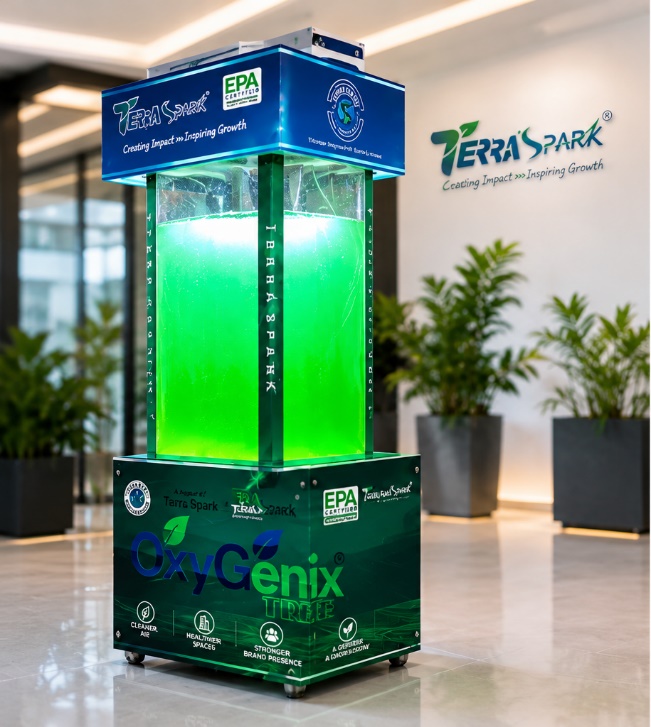
Smog is more than a seasonal inconvenience; it is a serious public health challenge that requires multiple solutions. One emerging local initiative is the OxyGenix Tree, described as Pakistan’s first EPA-certified liquid tree. Developed by Terra Spark, a Faisalabad-based sustainability and climate-tech company, the technology uses a microalgae-based system as part of a broader approach to environmental innovation. This blog explores what causes smog, its impact on health and the economy, and how the OxyGenix Tree fits into Pakistan’s efforts to address air pollution.
What Is Smog, and Where Does It Come From?
Smog is a form of air pollution that can reduce visibility. The word combines “smoke” and “fog.” In Punjab, winter weather conditions can trap fine particles (PM2.5), gases and smoke close to the ground, worsening air quality.
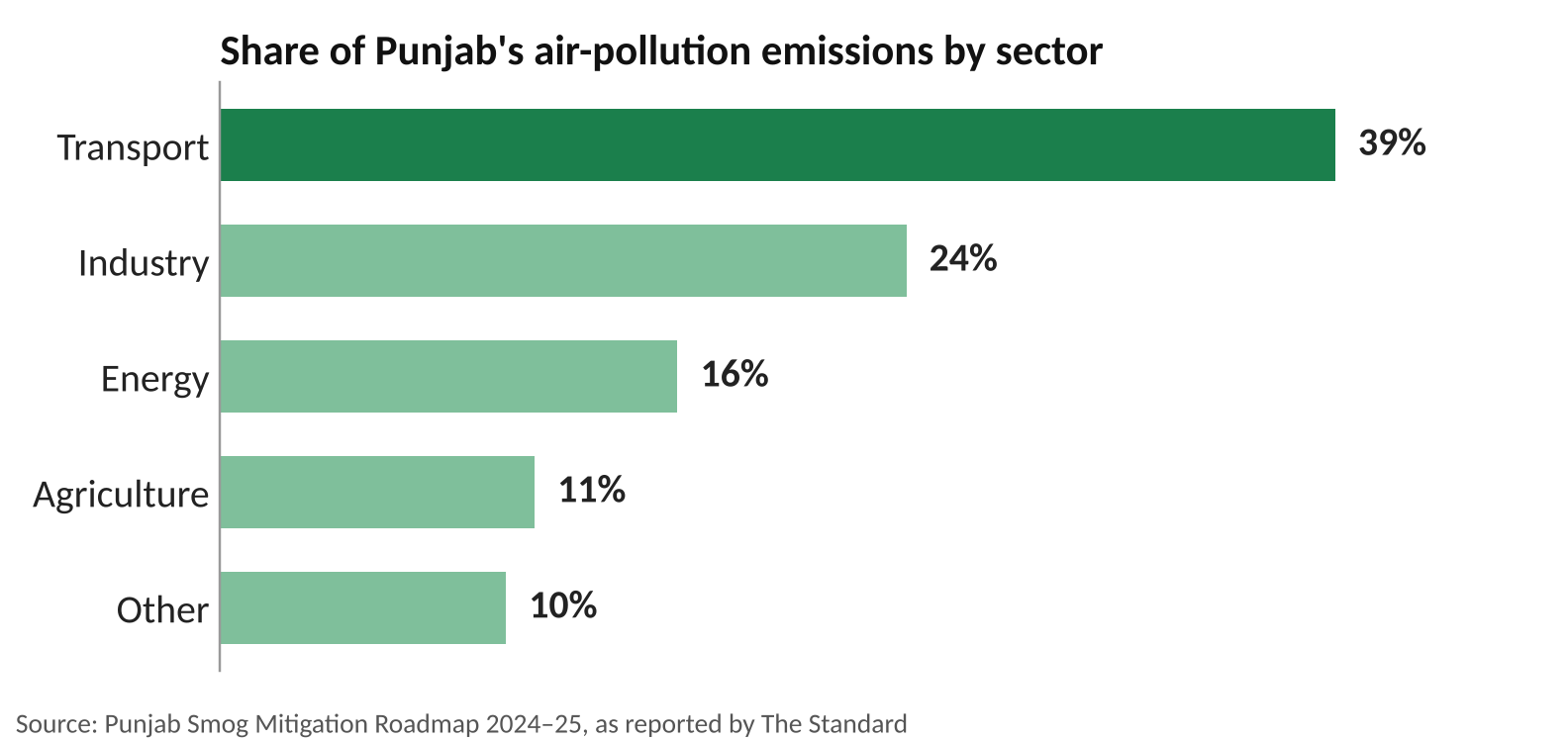
Punjab’s Smog Control Strategy 2024–25 identifies transport as the largest contributor in its sectoral emissions inventory, at 39%, followed by industry (24%), energy (16%) and agriculture (11%). Other sources of pollution include crop-residue burning, brick kilns, waste burning and emissions from older diesel vehicles. Research highlights the significant contribution of domestic emission sources to Punjab’s air pollution, although regional pollution can also play a role.
The key takeaway is that smog has multiple sources. No single ban or machine can solve the problem on its own; effective action requires a combination of emission controls, policy enforcement and cleaner technologies.
The Real Cost: Health and the Economy
Smog is measured using the Air Quality Index (AQI), but its true cost is reflected in its impact on human health and lives. A December 2025 report by the Pakistan Air Quality Initiative (PAQI) estimates that air pollution reduces the average Pakistani’s life expectancy by 3.9 years. It also estimates that Lahore residents could gain 5.8 years of life expectancy if air quality met global safety standards.
The World Health Organization (WHO) links exposure to fine particulate matter (PM2.5) with cardiovascular and respiratory diseases, as well as lung cancer. It estimates that outdoor air pollution caused 4.2 million premature deaths worldwide in 2019.
The impact extends beyond health to the economy. A December 2025 editorial in The News cites estimated annual economic losses of $22 billion due to air pollution, equivalent to approximately 6.5% of Pakistan’s GDP.
Why Planting Trees Alone Is Not Enough
Trees are the best long-term answer to dirty air, and plantation drives must continue. But they have limits in a crowded city. A sapling absorbs far less carbon than a mature tree and takes years to make a noticeable difference. Rooftops, mall courtyards, campuses and factory grounds often have no room for a forest at all.
This is the gap green technology is meant to fill. Officials describing Punjab’s liquid tree project say it is intended to complement tree plantation in urban areas where large-scale afforestation is not feasible. It adds to forests; it does not replace them.
Green Technology and the Idea of a Liquid Tree
A liquid tree is a photobioreactor: a transparent tank of water holding microalgae. Through photosynthesis, the algae take in carbon dioxide and release oxygen. Liquid trees are not a replacement for real trees. Their strength is different: a compact, controllable unit that can be placed where a tree cannot grow. Terra Spark, a Faisalabad-based sustainability company, has built Pakistan’s own version of this idea.
OxyGenix Tree: Terra Spark’s Liquid Tree for Pakistan
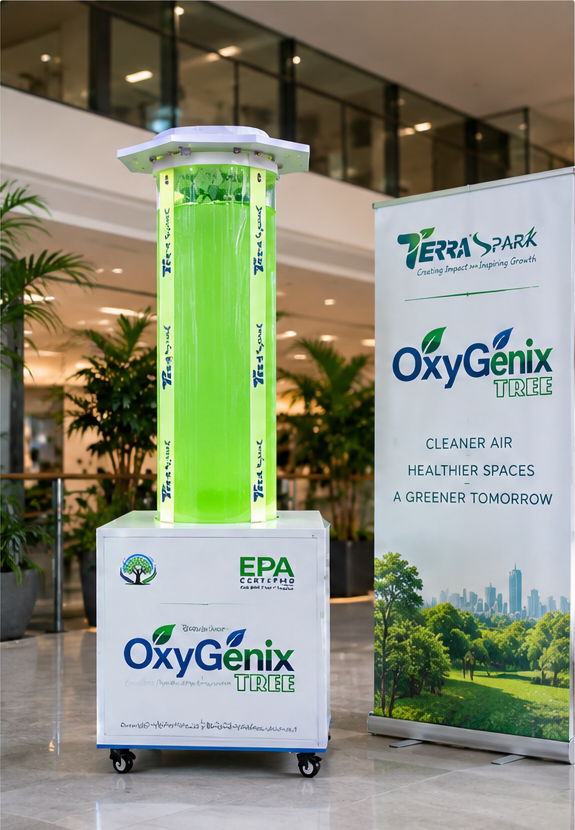
The OxyGenix Tree is Terra Spark’s flagship product: a smart, AI-integrated bio-reactor designed, developed and tested by Terra Spark, a Faisalabad-based sustainability company that also offers Carbon Footprint & Net Zero and Sustainability Strategy & ESG services. It pulls in surrounding air, treats it with a microalgae system, and reports what it is doing through live sensors and a dashboard, so results can be checked instead of taken on trust. Terra Spark’s first OxyGenix Tree blog explains the technology in detail.
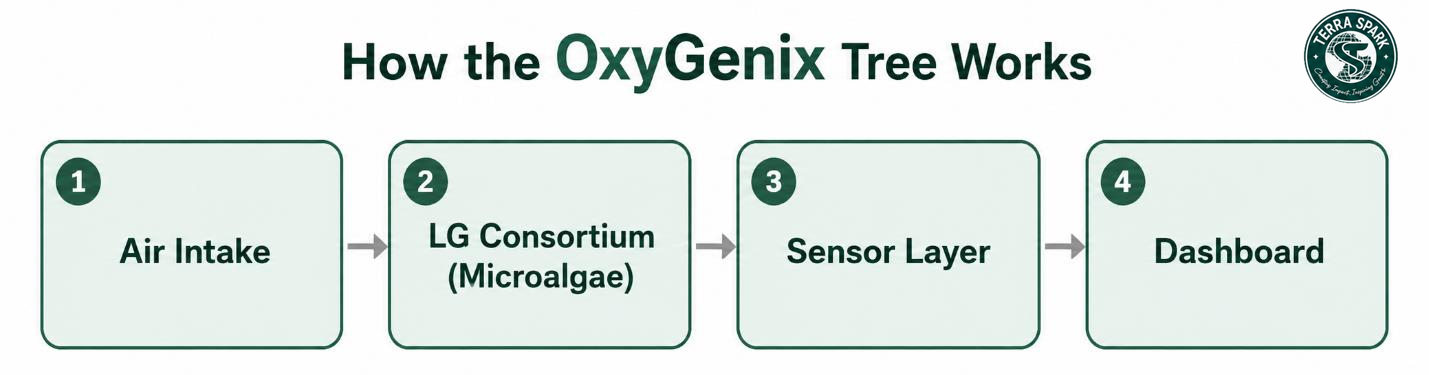
It works in four connected stages:
- Air intake: the unit draws in the air around it.
- Microalgae system: the algae consortium absorbs CO₂ and releases oxygen.
- Sensor layer: sensors track air quality, temperature, humidity, CO₂ levels and the unit’s own performance.
- Dashboard: data goes to the cloud and appears as live monitoring, alerts and trends.
The algae are chosen with care. Researchers collected more than 100 microalgae species from across Pakistan and tested their carbon-capture ability over seven months. The strain that performed best came from Sukkur and was cultivated with the support of Government College University Faisalabad.
Before a unit is installed, Terra Spark assesses the site for visibility, power access, pollution levels and foot traffic. After installation, the dashboard is set up for real-time tracking, and data from the pilot guides where to expand next. Likely users include government and smart-city projects, universities, climate events, factories and corporate offices running CSR programmes.
From Pilot to Policy: What Has Happened So Far
In June 2026, Punjab Chief Minister Maryam Nawaz announced Pakistan’s first EPA-certified liquid tree, describing it as the first technology to receive Punjab EPA certification since 1987. The government decided to expand the project, moving the certified unit from Faisalabad to Lahore, with the first phase placing liquid trees in major shopping malls and public spaces.
Terra Spark’s CEO, Dr. Sarfraz Ahmad, said the OxyGenix Tree has received formal EPA certification and occupies much less space than conventional trees. Terra Spark has since announced two further steps: a Technology Transfer Agreement with Government College University Faisalabad for an algae-based bioreactor, and, on 29 July 2026, an agreement naming Meridian Power Pvt. Ltd. its exclusive authorized solutions provider for public-sector collaboration.
Cleaner Air Needs Many Tools, and This Is One
Smog will not end with one machine. It needs stricter enforcement on transport, industry and crop burning, more trees, and technology that works where trees cannot. Carbon capture and smog are also not the same thing: smog is mostly fine particles, so a unit’s results should be judged with pollutant-specific measurements, which is exactly why a live dashboard matters. The OxyGenix Tree belongs in that last group: a compact, certified, data-reporting unit from Terra Spark that gives cities and institutions a visible, measurable step toward cleaner air.
Interested in piloting OxyGenix Tree at your campus, facility or city? Contact the Terra Spark team to discuss site assessment, deployment planning and how OxyGenix Tree can support your sustainability goals.