Human activities such as electricity generation, transport, industry, agriculture, and land-use change release large amounts of greenhouse gases and warm the planet. To measure these impacts, governments and businesses use a shared vocabulary. Knowing these carbon terms helps you follow climate discussions and judge sustainability claims more carefully.
Quick answer: The 10 key terms are carbon credits, carbon emissions, carbon offsets, carbon tax, carbon sinks, carbon neutral, CO2e, carbon markets, carbon registries, and carbon accounting.

1. What Are Carbon Credits?
A carbon credit is a unit representing one metric tonne of carbon dioxide equivalent (CO2e) reduced, avoided, or removed under a defined programme. Credits can come from forest restoration, methane capture, or certain clean-energy projects. Their value depends on project quality and how the impact is measured and verified. Credits should complement real emission cuts, not replace them.
2. What Are Carbon Emissions?
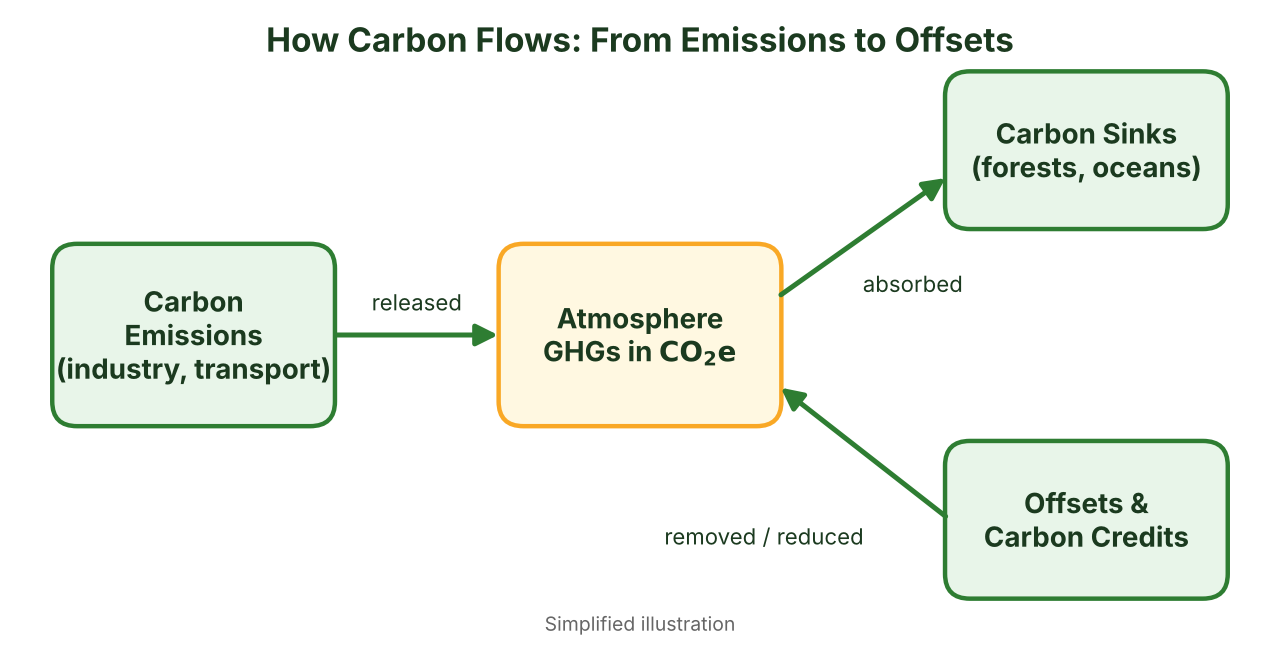
Carbon emissions usually mean carbon dioxide released into the atmosphere, though the phrase is often used for all greenhouse gases. Main sources are burning coal, oil, and gas, clearing forests, and some industrial processes. Measuring emissions shows organisations where reductions will matter most.
3. What Is a Carbon Offset?
A carbon offset is a reduction or removal of greenhouse gases used to compensate for emissions made elsewhere. For example, a company might fund a verified forest restoration or methane capture project. Offsetting is most credible when emissions are measured first, avoidable emissions are cut, and the project delivers additional, lasting benefits.
4. What Is a Carbon Tax?
A carbon tax is a government charge based on the greenhouse gases emitted, often linked to the carbon content of fuels. It puts a price on pollution and encourages efficiency or a switch to cleaner energy. How well it works depends on the tax rate, its design, and how the revenue is used.
5. What Is a Carbon Sink?
A carbon sink is a natural or engineered system that absorbs more carbon than it releases. Forests, oceans, wetlands, and healthy soils are the main natural sinks. Deforestation, fires, warming, and land degradation can weaken them, so they work best alongside deep cuts in fossil-fuel emissions.
6. What Does Carbon Neutral Mean?
Carbon neutral means the emissions of a person, product, event, or organisation are balanced by an equal amount of reductions or removals over a defined period. It does not mean zero emissions were produced, so a good claim must state what is included and how the balance is achieved.
Carbon Neutral vs Net Zero
Net zero usually means cutting emissions as far as possible, often against a long-term target, and balancing only the small residual with permanent removals. Carbon neutral only requires emissions and offsets to balance over a set period. A net-zero claim is generally the stricter of the two.
7. What Is Carbon Dioxide Equivalent (CO2e)?
CO2e is a common unit for comparing different greenhouse gases. Gases like methane and nitrous oxide trap heat differently and last for different lengths of time. CO2e converts their warming effect into the amount of CO2 that would have a comparable effect over a set time horizon.
Example: Over 100 years, one tonne of methane has roughly 28 times the warming effect of one tonne of CO2, so it counts as about 28 tonnes of CO2e (IPCC AR6).
8. What Is a Carbon Market?
A carbon market is a system for trading carbon allowances or credits. Compliance markets operate under laws or regulatory schemes, such as emission limits. Voluntary markets let organisations buy credits without a legal obligation, often to support climate commitments. Integrity depends on accurate measurement, strong rules, transparency, and safeguards against double counting.
9. What Is a Carbon Registry?
A carbon registry records the issuance, ownership, transfer, and retirement of carbon credits. This helps prevent the same credit from being claimed more than once. A registry entry alone does not prove quality, so also check the standard, methodology, and verification records behind the credit.
10. What Is Carbon Accounting?
Carbon accounting is the process of measuring, recording, and reporting greenhouse gas emissions and removals. Organisations usually look at direct emissions, indirect emissions from purchased energy, and other value-chain emissions such as suppliers, transport, and product use. A reliable inventory helps set targets, track progress, and find ways to save energy.
Frequently Asked Questions
What is the difference between a carbon credit and a carbon offset?
A carbon credit is the tradable unit (one tonne of CO2e). A carbon offset is the act of using those credits to compensate for your own emissions.
Is carbon neutral the same as net zero?
No. Net zero is generally stricter: it prioritises deep emission cuts and balances only a small residual with permanent removals.
Why is CO2e used instead of just CO2?
Different greenhouse gases warm the planet differently. CO2e puts them all in one comparable unit.
Can carbon offsets replace emission reductions?
No. Offsets should complement real reductions, not replace them.
Conclusion
Understanding these ten carbon terms makes it easier to read climate reports, compare company claims, and spot greenwashing. Start with emissions and accounting, then look at credits, offsets, and markets with a critical eye.
Want to take climate action? Explore Terra Spark to see how we are working on a greener future.