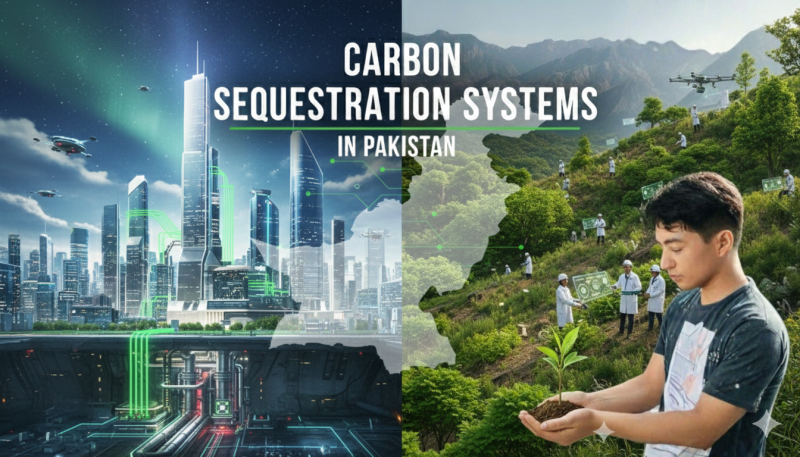
Our Best Hope Against Climate Change
We contribute less than 1% to global greenhouse gases. Yet, we are already living through climate hell. The only way to survive the coming decades is to remove carbon from the atmosphere as fast as possible, and luckily, some of the world’s most powerful natural carbon sequestration tools are right here at home.
What is Carbon Sequestration?
It is the process by which CO₂ is pulled from the air and locked away for decades or centuries. It is happening naturally through forests, soils, mangroves, wetlands, and oceans. Pakistan has all of these — and we are finally starting to use them smartly.
Forests & Reforestation – Our Biggest Carbon Sink
Currently, the forests of Pakistan absorb ~10–12 million tons of CO₂ every year.
More than 2.5 billion trees have already been planted under the Ten Billion Tree Tsunami Programme for 2018–2023 and the current Ecosystem Restoration Initiative.
The Billion Tree Tsunami in Khyber Pakhtunkhwa alone increased the forest cover by 6% and is estimated to sequester 5.8 million tons of CO₂ over its lifetime.
New focus: Miyawali urban forests in Lahore, Karachi, and Islamabad – these grow 10× faster and absorb 30× more carbon per hectare than normal plantations.
Indus Delta Mangroves: The Superhero of Carbon Capture
Pakistan has the 8th largest mangrove cover in the world (~600,000 hectares). The mangroves in Sindh and Balochistan can store up to 4× more carbon per hectare than tropical rainforests — that’s “Blue Carbon” power! The Indus Delta mangrove project together with WWF-Pakistan and the Sindh Forest Department has planted more than 500,000 hectares since 2013.
Result: 1 ha of healthy mangrove can sequester ~12–15 tons of CO₂/yr and protects coastal communities from cyclones and erosion.
Regenerative Agriculture & Soil Carbon
80 percent of the land in Pakistan is used for agriculture; if we switch to carbon-smart farming, the impact will be huge.
Practices currently under test:
Zero-tillage & happy seeder machines in Punjab ,Cover cropping and crop rotation, Biochar application – turns crop waste to long-lasting soil carbon Pilot projects in Punjab and Sindh show that soil can sequester from 0.5 to 2 tons of carbon per hectare per year by only changing farming methods.
Emerging Technological Solutions
While DAC technology remains expensive, there are hopes that Pakistani startups and universities-NUST and LUMS-are working on inexpensive sorbents manufactured from local materials like rice husk and bagasse. Sequestration based on ocean processes: Preliminary studies have focused on kelp farming and alkalinity addition in the Arabian Sea.
How Much Carbon Can Pakistan Actually Sequester?
Conservative estimates (2024 studies):
- Existing + new forests → 25–30 million tons CO₂/year by 2030
- Mangrove expansion → extra 8–10 million tons/year
- Soil carbon farming on 10 million hectares → 10–15 million tons/year
- That’s almost 20–25% of our current annual emissions locked away naturally!
Challenges We Must Fix
- Illegal logging and urban expansion eat into the forests.
- Shrimp farming wiping out mangroves
- Absence of carbon credit markets (where farmers and communities are not paid for sequestering carbon as yet)
- Weak monitoring and verification systems
The Way Forward
- Create a National Carbon Credit Registry so that communities earn money when they protect forests and mangrove ecosystems.
- Reward regenerative practices with “carbon farming” incentives to farmers.
- Declare the Indus Delta mangroves a UNESCO World Heritage Site for global protection and funding.
- Carbon sequestration goals should be included in the updated NDCs for COP30. Pakistan did not cause the climate crisis, but we have some of the best nature-based solutions in the world. If we protect and expand our forests, mangroves, soils, and wetlands-and reward the people who do it-we can become a global leader in natural carbon removal. Let’s stop waiting for the world to save us. Our trees, our mangroves, and our soil can do it — if we give them a chance.