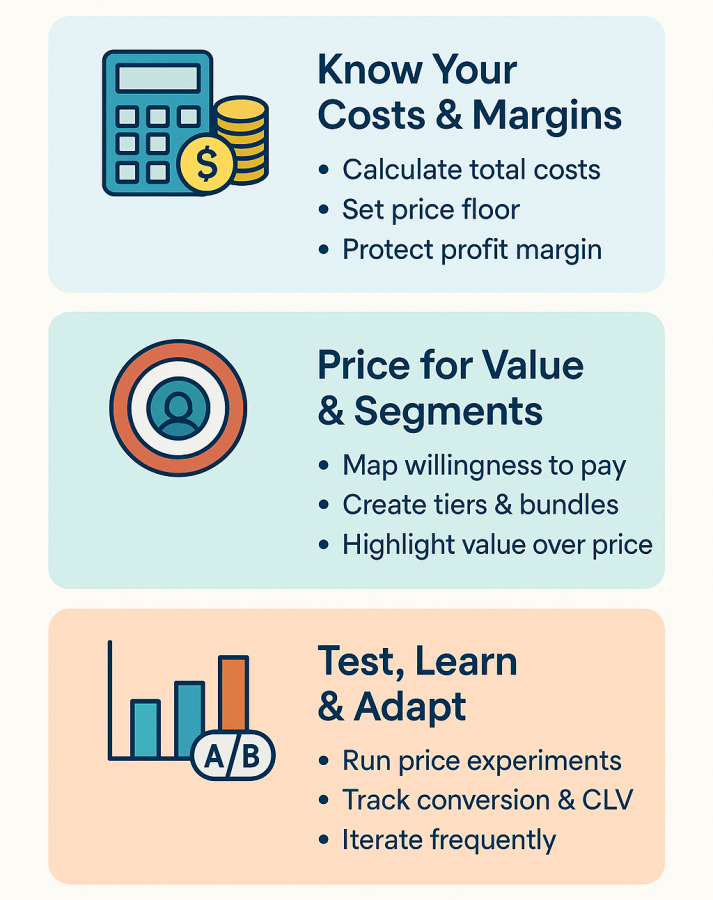
As a small business owner, you know that pricing your products or services can be one of the most challenging aspects of running your business. Get it right, and you can increase your revenue and customer loyalty; get it wrong, and you risk losing out to competitors. Here are three effective strategies to optimise your pricing approach and ensure that it reflects the value you provide while keeping your customers engaged.
Know your true costs to set profit-saving floors, then craft value-based tiers that match each customer segment. Run small, data-driven price tests, tracking margins, conversion, and CLV—and iterate fast to stay ahead.
- Understand Your Costs and Profit Margins
Before setting any prices, it’s crucial to have a clear understanding of your total costs. This not only includes the direct costs associated with your products or services but also indirect costs like utilities, rent, and marketing expenses. Calculating your break-even point—the minimum sales needed to cover your costs—will give you a strong foundation for your pricing strategy.
Additionally, determine your desired profit margin. This simple formula can guide you:
Selling Price = Cost + (Cost x Desired Profit Margin)
By understanding your costs and setting realistic profit margins, you can price your offerings to sustain and grow your business effectively.
- Research Your Competitors
The marketplace is not just about you; it’s filled with competitors, both big and small, striving for the attention of your target audience. Conduct a competitive analysis to find out how similar products or services are priced. This information can help you position your offerings attractively while still maintaining profitability. Consider different pricing tactics. Are competitors offering discounts? Or perhaps they’re enhancing value with bundled services? Identifying these strategies can help you innovate your pricing approach—whether that means adopting competitive prices to capture market share or differentiating your service through unique offerings at a premium price.
- Test and Iterate Your Pricing
In the ever-evolving landscape of small business, flexibility is key. Don’t be afraid to experiment with your pricing. Use A/B testing—where you offer different prices to different customer segments—to see how they respond. Pay attention to sales data and customer feedback; it can provide invaluable insights about what works and what doesn’t. Consider seasonal adjustments or promotional pricing, especially during low-demand periods, to encourage purchases. Continuously gathering analytics and refining your pricing strategy based on data will keep you responsive and competitive.
Conclusion
Optimising your pricing strategy is an ongoing process that requires a healthy blend of analytics, market understanding, and creativity. By understanding your costs, monitoring your competitors, and being open to testing various approaches, you can develop a pricing strategy that not only enhances your bottom line but also fosters lasting relationships with your customers. Remember, the right price reflects the value you provide while keeping your customers eager to return for more.
For more insights on pricing and small business strategies, stay tuned for our next post! If you have any questions or would like to share your experiences, feel free to contact us. Let’s grow together on this journey!